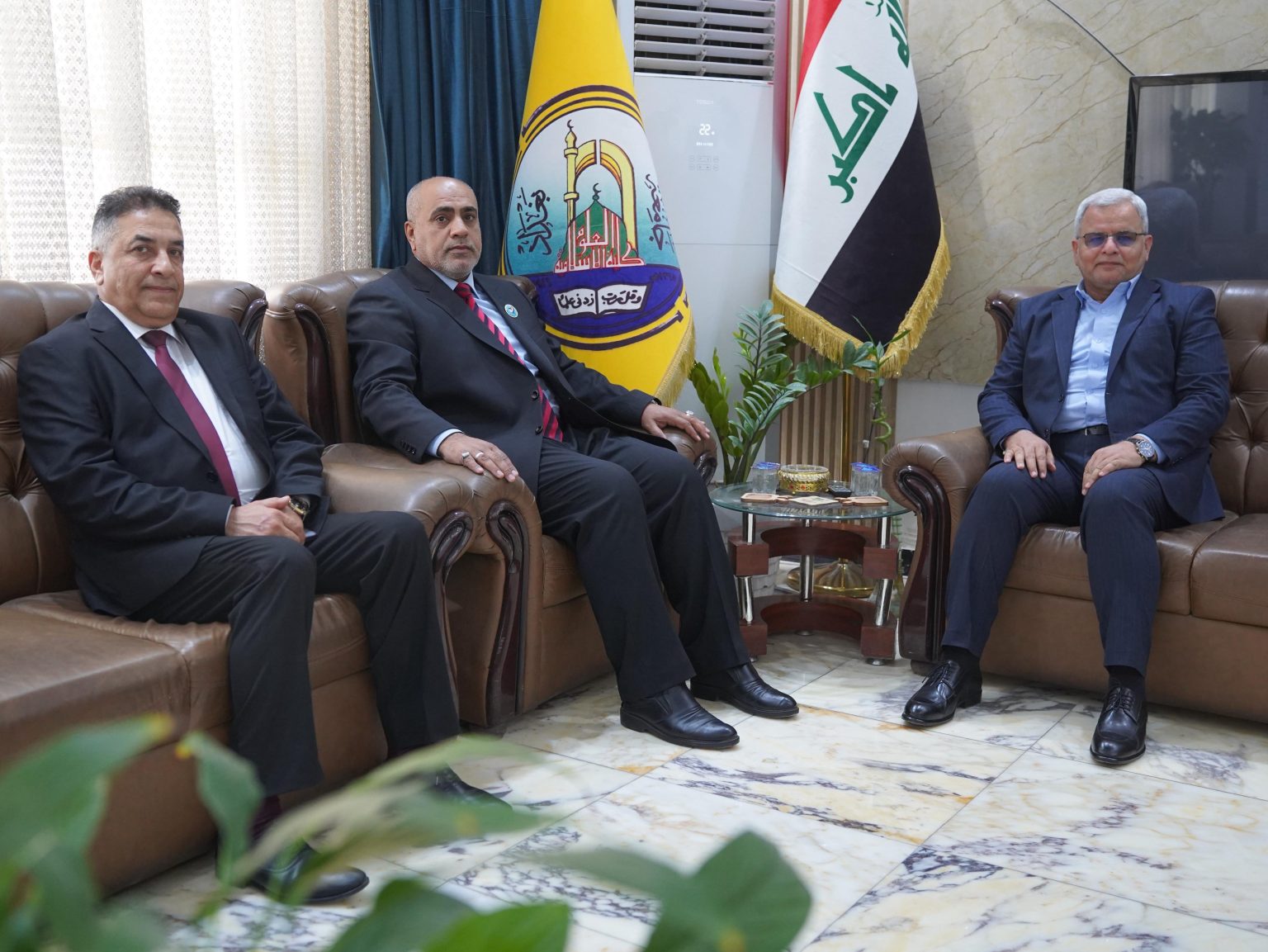
The College of Islamic Sciences at the University of Baghdad hosted a dialogue seminar under the patronage of the Office of the Prime Minister, supervised by the university presidency, and followed up by its deanery. The seminar was entitled “The Religious Authority’s Vision Of The Current Challenges Facing Iraq” and aimed to deconstruct the paternal discourse of the religious authority and transform it into national action programs that safeguard collective identity and strengthen the foundations of social peace in the face of rapid changes.
The seminar began with intellectual approaches presented by Dr. Haider Al-Saadi, Advisor to the Prime Minister and Head of the Supreme Central Committee for Awareness, who emphasized the necessity of intellectual clarification and the consolidation of values of acceptance of others as both a moral and national imperative. His perspective intersected with the constitutional argument of Professor Dr. Abdul Jalil Munshid, President of Imam Al-Kadhim University, who affirmed that the people are the primary source of legislation and the constitution, citing historical positions of the religious authority on critical issues in Iraq and the region, particularly its supportive stances toward Gaza and Lebanon. The discussion then shifted to sovereignty and security matters with Major General Dr. Saad Maan, Head of the Security Media Cell, who articulated the equation of stability as requiring the restriction of arms, the strengthening of state institutions, and the rejection of any divergence that undermines public order, considering these measures the true safeguard against extremism.
This seminar did not remain confined to theoretical discourse but aligned in essence and outcomes with the Sustainable Development Goals. It directly intersected with Goal 16, which focuses on promoting peace, justice, and strong institutions; Goal 4, which emphasizes quality education and the dissemination of values of tolerance; and Goal 17, which highlights the importance of strategic partnerships between executive institutions, academia, and religious leadership.


