
Iraqi universities may need to rethink how they measure academic quality — not by how well a program performs today, but by how ready it is for tomorrow.
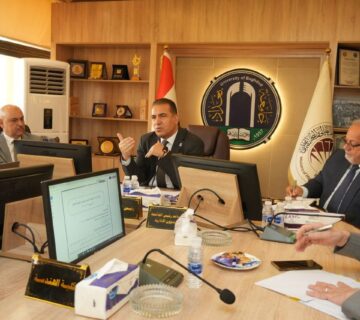
That was the core message from University of Baghdad President Prof. Dr. Alaa Abdul-Hassan Al-Zughaibi, who delivered a lecture titled “The Future Transformation Index for Academic Programs” to members of the University Council, assistant deans for scientific affairs, and department directors from the university presidency, held at the Institute of Genetic Engineering and Biotechnology for Postgraduate Studies.
Al-Zughaibi outlined a vision for modernizing academic programs that shifts away from traditional curriculum review toward a forward-looking approach — one that measures a program’s ability to adapt to future demands using indicators that account for advances in knowledge and technology, digital transformation, artificial intelligence, future skills, and the fast-changing needs of the job market and society.
He said universities are no longer tasked simply with preparing graduates for today’s jobs, but with building academic programs that can anticipate the professions, specializations, and skills society will need in the years ahead. A program’s quality, he added, should be judged not just by its current standing, but by its ability to stay effective, flexible, and adaptable in a rapidly evolving academic and professional environment.
The proposed index, Al-Zughaibi explained, would serve as a diagnostic tool to assess how ready existing programs are for the future, identifying strengths and gaps that need addressing. This would help colleges and academic departments make informed decisions about updating curricula, launching new specializations and tracks, or restructuring programs whose outcomes no longer align with future trends.
He described the initiative as part of the University of Baghdad’s broader vision to build a flexible, sustainable academic system that integrates teaching quality with research, innovation, digital transformation, artificial intelligence, and labor-market needs — strengthening the competitiveness of the university’s graduates both locally and internationally, and reinforcing the university’s role as a leading institution shaping the future of higher education in Iraq.
The lecture prompted extensive academic discussion on how to translate this vision into measurable, actionable steps across the university’s colleges and programs, including the development of indicators to evaluate how ready academic programs are for future change.
The initiative reflects the university’s broader effort to move from reacting to change after it happens to anticipating and shaping it — reinforcing the university’s role in preparing generations equipped with the knowledge, skills, and capacity to innovate, compete, and contribute meaningfully to development and the future.