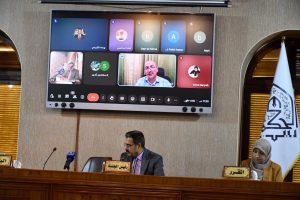
Professor Dr. Ihsan Ali Al-Haidari, Chair of the National Council for the Accreditation of Colleges of Arts, Languages, and Archaeology in Iraqi Universities, and faculty member in the Department of Philosophy at the College of Arts, University of Baghdad, participated in an international symposium organized by the House of Wisdom. He presented a research paper titled “The Trajectory of Meaning: A Study on the Evolution of Philosophical Theories from Theology to Language.” The symposium was held under the theme “Language and Meaning in Linguistic and Philosophical Approaches,” with contributions from scholars representing various universities both within Iraq and abroad.
The paper explored the major intellectual phases that the concept of “meaning” has undergone—beginning with the medieval era, which viewed meaning as an absolute divine truth; transitioning through the modern age, which linked it to human reason; and culminating in the twentieth century, where meaning came to be understood as a linguistic phenomenon shaped within language itself.
The study employed a historical-critical analytical methodology and incorporated the concept of epistemological rupture. It offered an in-depth reading of the ideas of prominent philosophers such as Augustine, Thomas Aquinas, Descartes, Kant, Wittgenstein, Saussure, and Derrida.
In conclusion, Dr. Al-Haidari emphasized that the journey of meaning reveals a shift from stability to fragility. He called for moving beyond the linguistic turn and embracing cognitive sciences and artificial intelligence to achieve a deeper understanding of meaning in light of contemporary challenges.