

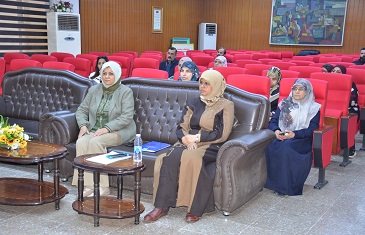
The Department of Chemistry, in cooperation with the Continuing Education Unit at the College of Science, University of Baghdad, held a scientific symposium entitled “The Spectrum of the Element in the Flame”, under the auspices of the Dean of the College, Assistant Professor Dr. Raed Faleh Hassan, and the presence of a number of graduate students, lecturers and those concerned with the specialization of chemistry.
The lecture aimed to clarify a method of chemical analysis that uses the intensity of light emitted by a flame, plasma, arc, or spark at a certain wavelength to determine the amount of an element in the sample, which gives the wavelength of the atomic spectral line, which is the identity of the element while the intensity of the light emitted is proportional to the number of atoms of the element, as well as its goal in clarifying the work of the atomic absorption device and its role in the emission of flame and atomic absorption spectroscopy, which measures the flame emission spectrometer of light emitted by atoms raised in flame, whereas an atomic absorption spectrometry measures light absorption by the atoms of the fundamental state.
The lecture included the definition of the basics of the work of the atomic absorption spectrometry device and providing applications for it, as the atomic absorption spectrum of the elements and the measurement methods used aim to know the concentrations of chemical elements in the solutions as well as to determine the relationship between the measured absorption and the concentration of the analysis with an explanation of the internal parts of the atomic absorption device such as the type of gas used and the types of solutions allowed to be used, as well as the composition of the flame, types of combustion zones inside the flame, special methods for preparing samples and the standard solution used, indicating that the absorption spectrometer device is one of the devices The task that works to analyze most of the important elements, whether in mercury, water and foodstuffs by absorbing light at a certain wavelength and fixed using their free atoms.
This symposium achieves one of the sustainable development goals represented by the seventh and fifteenth goals, which call for clean and affordable energy as well as life on earth.


