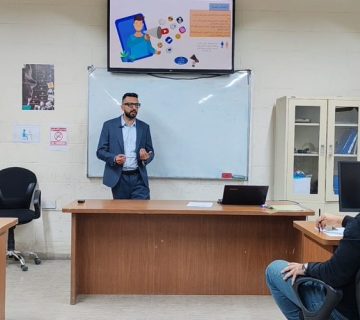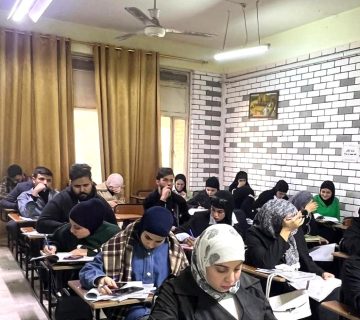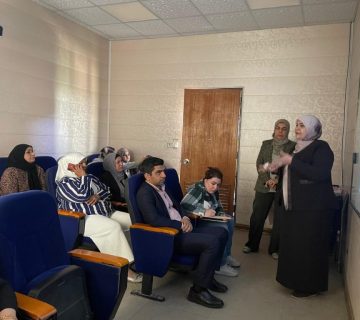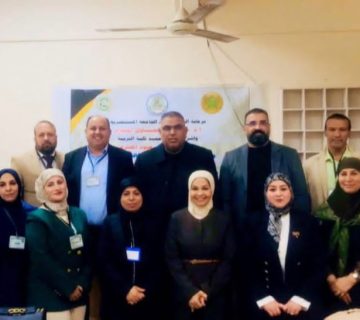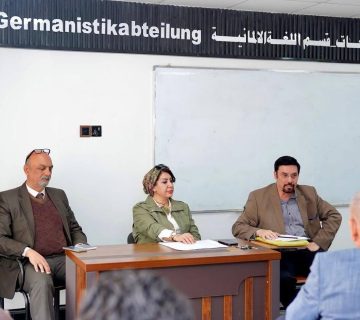

The Department of Astronomy and Space, in cooperation with the Continuing Education Unit at the College of Science, held a lecture entitled “Planetary Formation” in the presence of a number of students, researchers and those concerned with this issue. The lecture aimed to identify the planets of the solar system and the types of those planets and what are the most important theories developed about the origin of those planets in the solar system or Exoplanets and what is the relationship of the study of the spectral distribution of young stars in the classification of stars, as well as the study of the shape of the primary planetary disk that is formed at the beginning of the formation of young stars and its analysis, which takes approximately 10 million years to form.
The lecture was presented by Dr. Anas Salman Taha who highlighted the role of telescopes in detecting and monitoring these planetary disks, those scattered around the young stars that are born inside the cosmic nebulae, in addition to introducing the concept of transitional disks that are formed after the primary planetary disks and their relationship to the formation of the primary planet, indicating the most important physical processes that help in the formation of planets definitively.