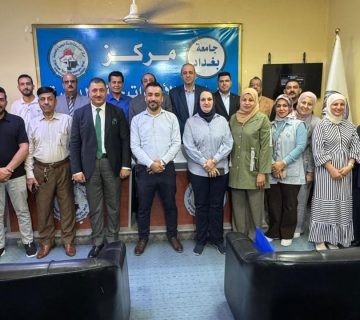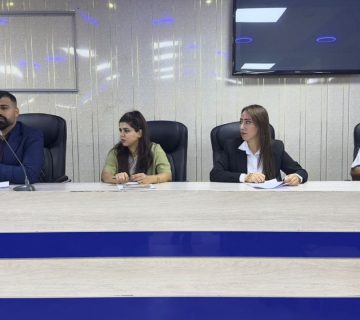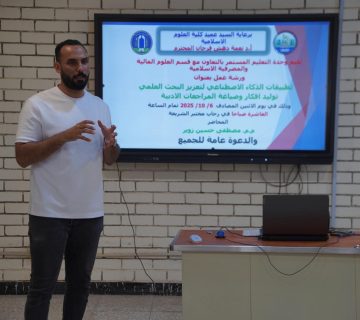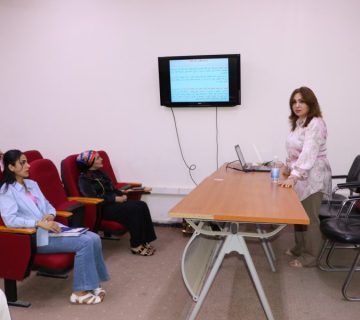

The Department of Environmental Engineering at the College of Engineering has sponsored a panel discussion entitled “Engineering Mechanisms and Principles of Industrial Rain Enhancement” delivered by Assist. Prof. Dr. Haider Muhammad Abdul Hamid, aimed at explaining and clarifying in detail the engineering mechanisms of this phenomenon and clarifying the principles of its work and technologies used on the global scale to ensure the provision of an additional water resource, while addressing the enhancing and auxiliary factors to increase rainfall and enhance the capacities of rain clouds in general, and explain and clarify the role of the environmental engineer mainly in this vital range.
The symposium witnessed a discussion of water scarcity and drought, which represents a major and haunting problem for many countries, especially those located in arid and arid regions, including Iraq, where the weather is characterized by high temperature and a long drought period that led to a decrease in rainfall, an increase in droughts and the demand for water with the scarcity of water resources from upstream countries and their negative effects on all joints of the daily life of citizens and their negative impacts on the economic, agricultural, social and environmental development plans. The lecturers provided some solutions to treat the lack of rainfall and drought in general, rain seeding clouds artificially or stimulate them to drop their content of water vapor and water inherent in them, and this approach has already begun to be applied in more than one Arab country and that has achieved very good success rates, but it is proven that resorting to rain enhancement techniques is no longer a luxury or an option, especially in light of the collapse of the problems resulting from the exacerbation of global warming condition and the recurrence of droughts.