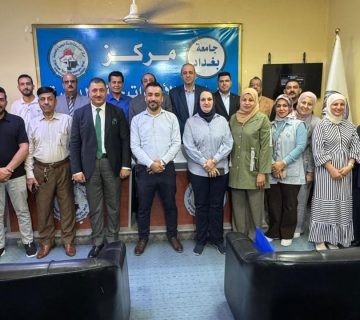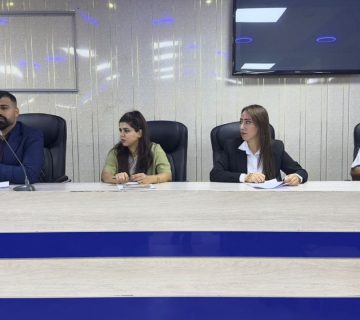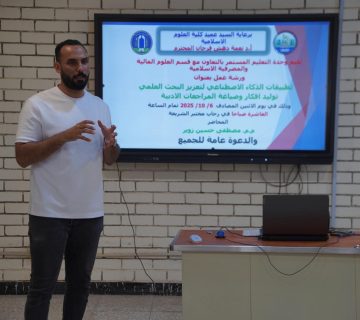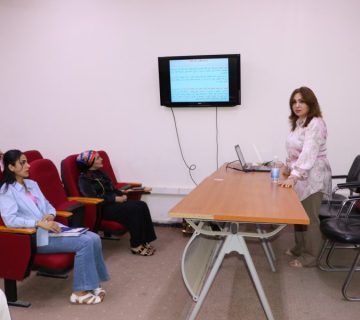

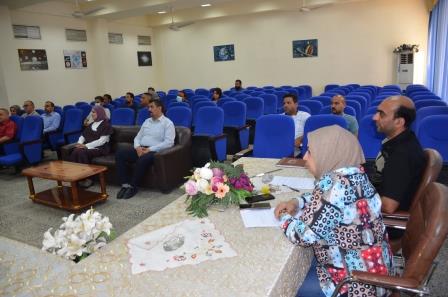
The Department of Astronomy and Space, in cooperation with the Continuing Education Unit at the Faculty of Science at the University of Baghdad, held the training course tagged “Different mathematical representations of the atmosphere and its impact on space imaging” with the participation of a number of students, researchers and those interested in this topic in particular or in physics and remote sensing in general.
The course was given by the Assist. Prof. Dr. Raed Nofi Hassan, Dr. Huda Shaker Ali and the lecturer Hassanein Hassan Ali with the aim to provide mathematical models of the atmosphere to describe the disturbances in the atmosphere and its strength and effects in astrophotography, especially when observing a star in the sky and the resulting atmospheric turbulence in the layers of the atmosphere and the most important continuous small changes in the optical properties of the air between the star and the telescope (or eye) and the refraction of which causes the light emitted by the star slightly, and the dancing of the astral image around the detector or on the retina. The professors then reviewed the results of luminosity caused by the change of refractive index in different layers of the atmosphere, indicating that this heterogeneity is caused by heterogeneity in the distribution of temperatures in different layers of the atmosphere in their concentrations and height from the surface of the Earth, inferring and as a result of absorption and refractive factors, concluding that the reflection and cylinder suffered by the light wave coming from stars, celestial bodies and distant galaxies, that may have effects on the clarity and spatial intensity of the image.