
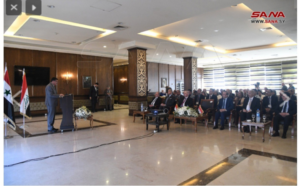
Prof. Dr. Riad Zuhair al-Zubaidi, a lecturer from the Department of Water Resources Engineering at the College of Engineering, has participated in the joint Iraqi-Syrian meeting held at the Syrian capital Damascus on the sustainable development where he contributed in the technical discussions between the members of the Iraqi and Syrian National Committees and the preparation of recommendations that concluded with the formation of a joint coordination committee whose task is to establish an electronic platform for the sharing of research and data between the two countries. Also they prepared a database related to water, environment and sustainable development, developing capacities, exchange experiences and communicating with international organizations to implement studies and applied research, support the integrated management of water resources technically and financially, spread community awareness; establish and develop water monitoring or climate stations.
The International Hydrological Program aims to meet the challenges and achieve sustainable development in the field of water resources at the local and international levels Iraq and Syria are the first two countries to start implementing the operational plan of this program in order to meet the common water challenges. It is worth mentioning that the participating delegation was headed by the minister of water resources and with the participation of His Excellency the Iraqi minister of environment, as well as the ministers of local administration, environment and higher education, the Chairman of the Syrian Planning and International Cooperation Commission and the Secretary-General of the International Hydrological Program to discuss the mechanisms of implementation of its operational plan which deals with the fields of scientific research, innovation, water education, sustainability, filling data and knowledge gaps, integrated management of water resources under the conditions of climate change, water governance, adaptation and confronting various challenges based on scientific foundations.