

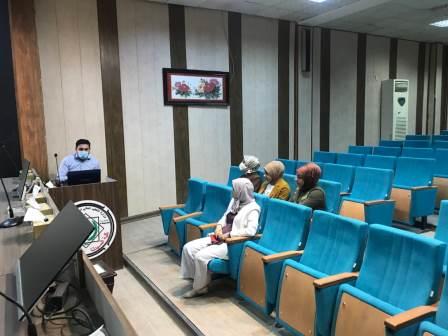
The Scientific Affairs Unit at the College of Pharmacy held a seminar on the vital signals of Hydrogen sulfide gas in the human body delivered by the lecturer Mahmoud Qahtan, a faculty member at the Medicines and Toxicology Branch, in which he stressed that the effective regulation of the breathing pattern is necessary for many processes in the body of different mammals, such as energy production, regulation of food metabolism and even speech. He stated that scientists recently discovered that the production of hydrogen sulfide is important for generating a normal breathing pattern, which could pave the way for new treatments for people with breathing disorders such as sleep apnea.
The lecturer then asserted that Hydrogen sulfide is produced in small quantities in the human body by an enzyme called Cystathionine beta and is thought to act as a bioactive gas to regulate various body functions. This enzyme is found in both the brain and surrounding organs including arteries, veins and kidneys. In a recent study published in the journal of Biological Sciences, researchers from the University of Tsukuba in Japan have investigated the role of hydrogen sulfide as a bioactive gas in the body, so first they tried to study the effect of inhibiting the activity of the Cystathionine beta enzyme in mice and thus inhibiting the production of hydrogen sulfide. They found that this led to a change in rats’ breathing patterns from normal to gasping pattern, concluding that the production of hydrogen sulfide allows the areas of the brain responsible for controlling breathing patterns to function normally.