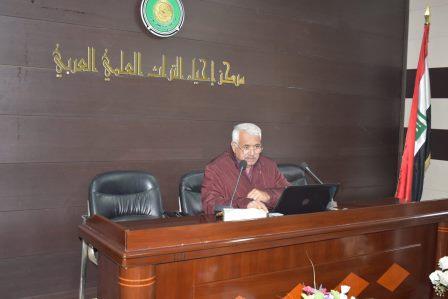
The Center for the Revival of Arab Scientific Heritage at the University of Baghdad has organized a seminar entitled ” Hashemite of Anbar in the light of archaeological excavations”, delivered by the head of the Department of Pure Sciences, Prof. Dr. Saadi Ibrahim al-Darraji. He addressed several topics, including defining the name of Anbar historically and outlined the importance of the Hashemite site of Anbar as a market and its strategic position and the history of the city and how it originated in the time of Abu Abbas named “The Butcher”, in which he built the mosque and the palace of the caliphate.
The researcher also focused on the results of excavations conducted by the General Authority for Antiquities in four seasons between (1999-2002) during which it revealed large residential lanes built with milk and wages, and obtained a valuable collection of collectibles and archaeological finds, especially pottery, glass, and metal. One of the most important is the coins, where excavations showed a treasure containing (700) gold coins dated at the beginning of the 7th century AH, all from Al-Nasir il-Din Allah Al-Abbasi. In this lecture, Dr. Saadi al-Darraji tried to stand on the importance of this city which contributed to the formation of a part of Islamic civilization and dedicated to the world a number of distinguished scientists and intellectual contributions.