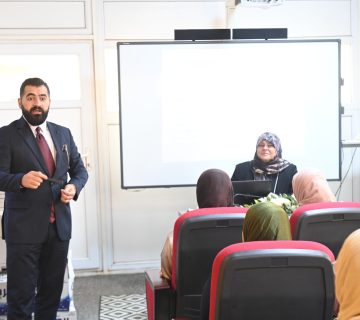

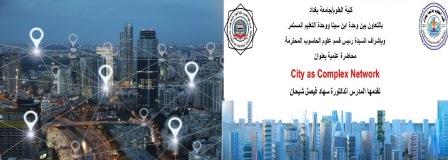
The Department of Computer Sciences, in collaboration with the Continuing Education Unit and Ibn Sina Unit for E-Learning at the College of Science has organized a virtual scientific lecture entitled “The city as complex network” with the participation of a number of students, researchers and those concerned with artificial intelligence and city planning.
The aim of the lecture was to treat cities as systems over the past 50 years, to identify the past two decades, and the changes in the focus from macro-balance systems to more sophisticated systems whose structure emerges from the bottom up, and the basics of a traditional approach that focuses on balance and model change to one that treats cities as emerging phenomena, arising through a set of hierarchical levels of decision, driven in a decentralized manner and consistent with the complexities that dominate the simulation of urban form and function. The lecture was presented by Dr. Suhad Faisal Sheehan, who reviewed a series of balance models, particularly those based on spatial interaction, and how simple dynamic frameworks can be formed to create more realistic models, by exploring dynamics, showing non-linear systems that recognize chaos and related complexity, as well as identifying more practical plans for structuring cellular-based urban models.