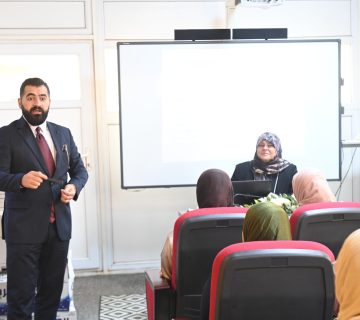
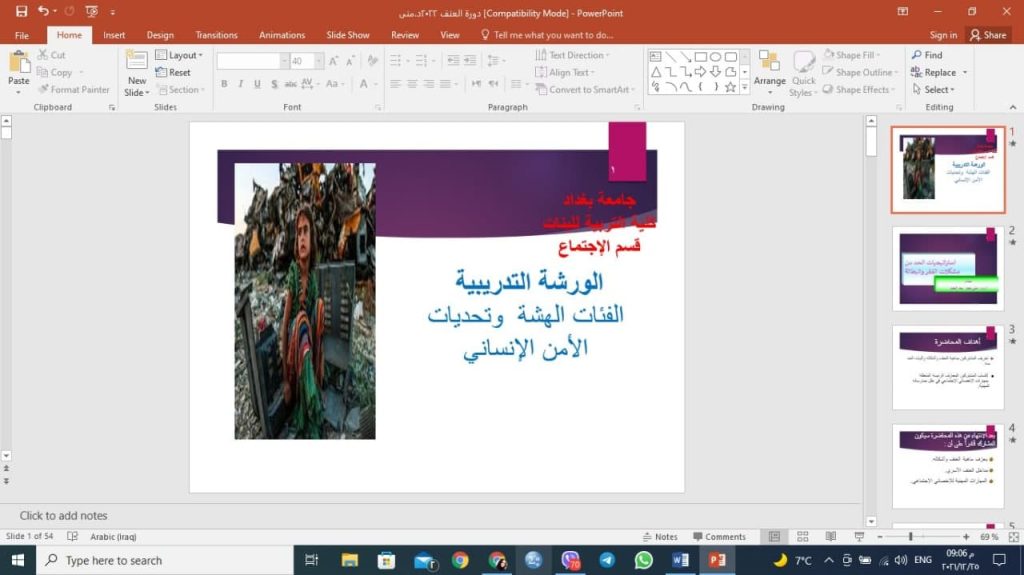
The department of sociology at the college of education for women held its training workshop entitled (fragile categories and human security challenges) via the Google Meet service with the participation of a number of faculty members (Adnan Yassin Mustafa, Alaa Mohammed Rahim, Muna Haidar Abdul Jabbar and Dina Dawood Mohammed). The workshop aimed to show the reality of the growing fragility and its causes in Iraq, which continues to face instability, many escalating social unrest, and the increasingly deep gap between the state and the citizen that has greatly affected the reality of human security.
The rates and proportions of vulnerable groups have increased in the midst of a number of crises, including the Covid-19 pandemic, growing dissatisfaction as well as the accumulation of weak economic policy effects, lack of reforms, inability to address corruption, economic instability, joblessness and poor service delivery, which are among the most important risks to the country’s long-term growth. Participation in the economy has declined, as Iraq is one of the countries with the lowest participation rates for women in the world’s workforce, and deteriorating working conditions without major reforms in these areas, leading to an increasing difficulty that Iraq will direct in achieving equitable sustainable growth to maintain a good standard of living in it.