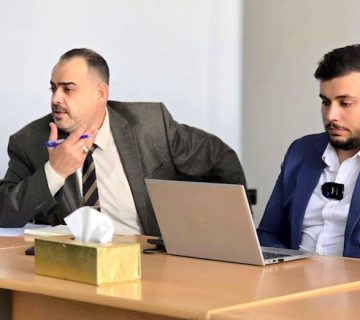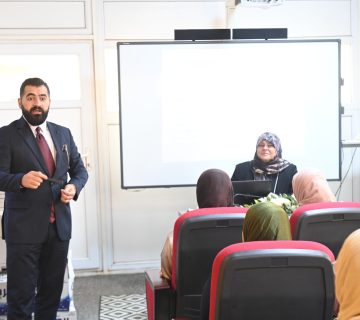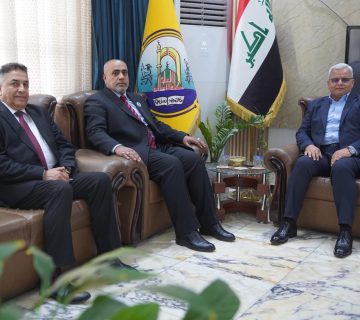

The Department of Physics at the College of Science has organized a lecture entitled “Applications of ultra-short fiber optic lasers (Femtosecond)” in the presence of the dean of the college, Prof. Dr. Abdul Kareem Abdul Razzaq and his assistants for scientific and student affairs. The lecture, which was attended by the head of the department of physics, Prof. Ali Abdul Latif, as well as a large number of students and lecturers, aimed to introduce the latest oral lasers discovered by the Arab scientist Ahmed Zewail, who was awarded the 1999 Nobel Prize in Chemistry for his work on femtochemistry and who contributed in a revolution in the interpretation of a wide range of natural phenomena and practical applications in the areas of life, and the advantages of ultra-short fiber lasers (Femtosecond) at a low cost, small size and wide spectrum, to generate lasers at different wavelengths for many modern applications, in addition to shedding light on the fundamental technological importance of these lasers in the fields of communication and optical sensors.
The lecture was presented by Prof. Dr. Hani Kabashi from the college of engineering and physics at Aston University in the United Kingdom, who addressed the design of ultra-short optical fiber lasers and their applications and uses in the interpretation of certain natural phenomena in various medical and industrial applications and the generation of high frequencies and their use in the 5G communications and LADAR sensor for automotive driving applications, as well as in the study of the interpretation of the phenomenon of forming giant waves called Rogue Wave. This is the main reason for the disappearance of many ships and boats in the Bermuda Triangle region, with the latest scientific discoveries being displayed worldwide, as well as the use of these lasers in medical applications for malignant tumor ingesting surgery as well as chemical detection sensors added to frozen food.