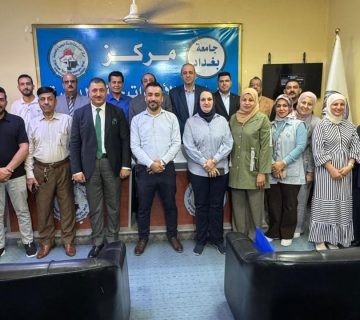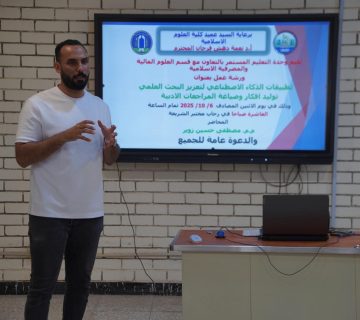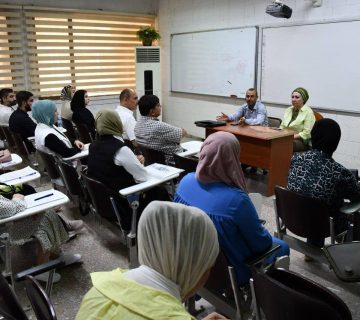

The Department of Political, Regional, and International Studies at the Center for Strategic and International Studies, University of Baghdad, organized a scientific workshop entitled Chip Manufacturing in the U.S.–China Competition, with the participation of researchers and academics specializing in international relations and the political economy of technology.
The workshop aimed to analyze global transformations in the semiconductor industry and its role in intensifying the geopolitical rivalry between the United States and China, given its central importance to national security and global balance. Researcher and Assistant Lecturer Riyadh Mohammed Khalbas presented key features of this competition and its implications for the future of technology and the global economy.
The workshop addressed global chip supply chains and the roles of major companies such as TSMC, ASML, Intel, and SMIC. It also reviewed U.S. policies aimed at curbing China’s progress in artificial intelligence and precision manufacturing, alongside Chinese efforts to achieve self-sufficiency in this vital sector. Discussions further explored the impact of this competition on the global economy and the Middle East region, particularly Iraq, in light of digital transformations and future investment opportunities in technological industries.
At the conclusion of the workshop, participants emphasized the need to support Iraqi scientific research in advanced technology fields and to strengthen academic cooperation with international centers to keep pace with global developments in semiconductor technology, data security, and digital transformation.
This activity aligns with Sustainable Development Goal 8 (Decent Work and Economic Growth) as well as Goal 9 (Industry, Innovation, and Infrastructure).